Shipping & packaging
How to Calculate Container Space Utilization
Container space utilization is a ratio of two volumes: what the cargo takes up and what the container holds inside. The arithmetic is short; the care goes into the measurements.
Ready to try the tool this guide describes?
The inside volume
Multiply the inside length, width, and height. An example container 232 × 92 × 94 in inside holds 2,006,336 in³, which is 1,161 ft³ or 32.88 m³.
The cargo volume
For each kind of item, multiply its three sizes by the quantity, then add the kinds together. 200 cartons of 24 × 16 × 12 in, 40 of 20 × 16 × 12 in, and 4 crates of 48 × 40 × 50 in come to 1,459,200 in³ — 844.44 ft³.
The ratio
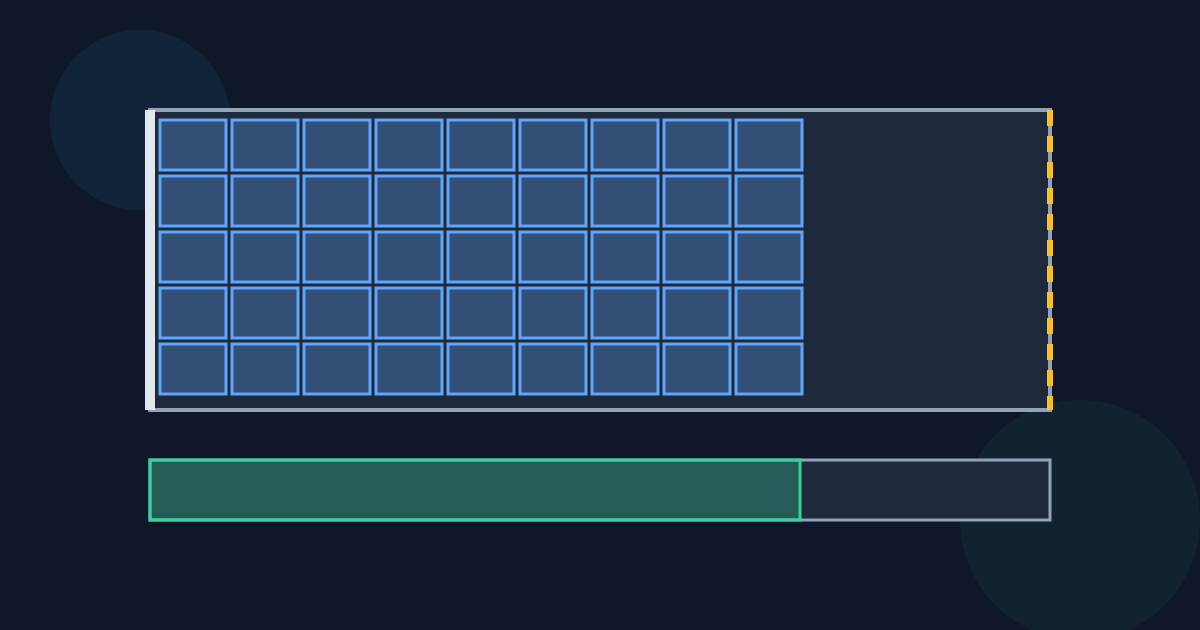
1,459,200 ÷ 2,006,336 = 72.73%. The unused 547,136 in³ — 316.63 ft³ — is space the cargo doesn’t take up, whether or not anything else could actually go there.
Worked examples
| Container inside | Cargo | Utilization |
|---|---|---|
| 232 × 92 × 94 in | 357 cartons of 24 × 16 × 12 in | 81.99% |
| 232 × 92 × 94 in | 200 + 40 cartons and 4 crates (above) | 72.73% |
| 232 × 92 × 94 in | 950 ft³ from a packing list | 81.82% |
What the percentage doesn’t say
A utilization below 100% doesn’t show that the cargo fits. Gaps between items and space above the top layer mean a real load fits less than the volumes suggest; checking that takes a layout, not a ratio.
Calculating Container Utilization FAQ
- How do I calculate container utilization from a packing list?
- Take the total cargo volume from the list and divide by the container’s inside volume. 950 ft³ in a 1,161 ft³ container is 81.82%.
- Should I use inside or outside container sizes?
- Inside. The cargo fills the inside, so the outside size overstates the space and understates utilization.
- How do I convert cubic inches to cubic feet?
- Divide by 1,728, since a cubic foot is 12 × 12 × 12 in. 2,006,336 in³ is 1,161.07 ft³.
- Can container utilization be over 100%?
- Only on paper. If the cargo’s volume is larger than the inside volume, it can’t all go in, however it is arranged.
- Does high utilization mean the load was well planned?
- It means little space is wasted. Weight, stability, and securing are separate checks.
Related guides
- Volume vs Floor SpaceWhy volume, floor-space, and length utilization give different answers for the same container load, and which one tells you the container is full.
- Setting a Utilization TargetHow to choose a realistic container utilization target from your own cartons, track the volume left to reach it, and spot a target no layout can meet.
Open the tool
Jump into Container Space Utilization Calculator when you are ready to process your files.