Calculators & everyday math
How Temperature Conversion Formulas Work
The Fahrenheit–Celsius formulas look arbitrary, but each part has a reason: the 32 accounts for the different zero points and the 5/9 for the different step sizes. Once you see that, you can rebuild the formulas yourself — and avoid the most common mistake.
Ready to try the tool this guide describes?
Two differences between the scales
- Different zero points: water freezes at 0 °C but at 32 °F.
- Different step sizes: 100 Celsius degrees span the same range as 180 Fahrenheit degrees, so a Fahrenheit degree is 100/180 = 5/9 of a Celsius degree.
Building the Fahrenheit-to-Celsius formula
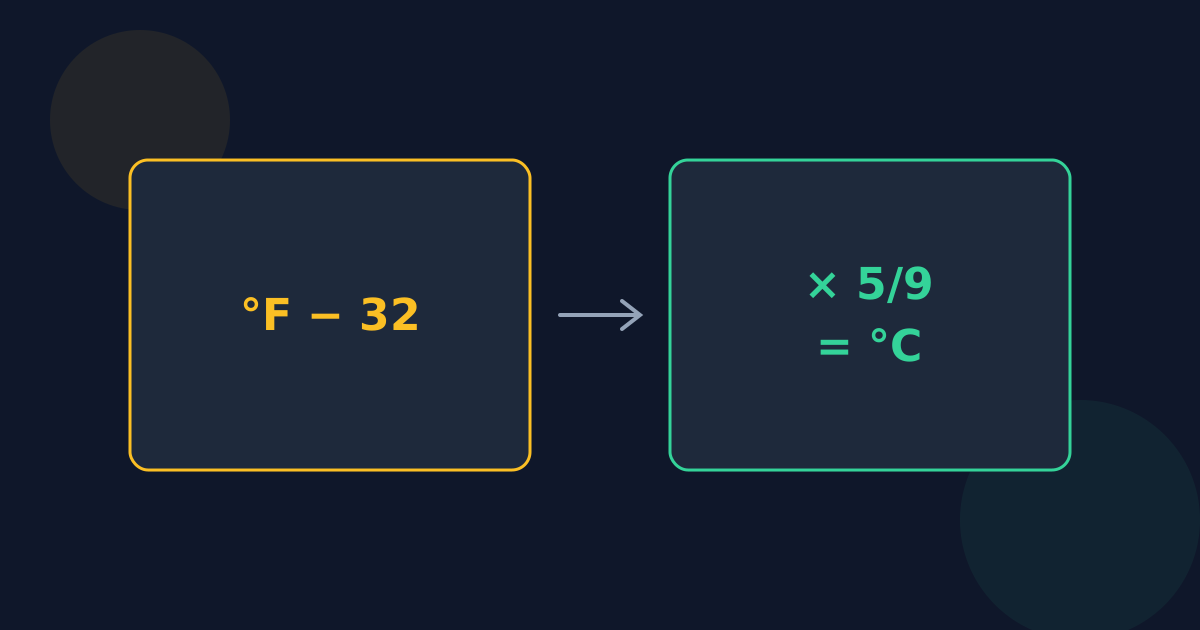
- Remove the offset so both scales start at freezing: F − 32.
- Rescale the degrees: multiply by 5/9.
- Result: C = (F − 32) × 5/9. For 212 °F: (212 − 32) × 5/9 = 180 × 5/9 = 100 °C.
Reversing it
Undo the steps in the opposite order: multiply by 9/5, then add 32. So F = C × 9/5 + 32, and 37 °C is 37 × 1.8 + 32 = 98.6 °F.
Readings vs. differences
The offset applies only to readings. A change in temperature is converted by the step size alone: a 10 °C rise is an 18 °F rise, not 50 °F. The Temperature Converter converts readings.
Adding kelvin
Kelvin uses Celsius-sized degrees but starts at absolute zero, so K = °C + 273.15. Combining the formulas gives K = (°F − 32) × 5/9 + 273.15.
Temperature Formulas FAQ
- Why subtract 32 before multiplying?
- The 32 is the gap between the zero points, so it has to be removed before the degrees are rescaled.
- Where does 5/9 come from?
- 100 Celsius degrees cover the same range as 180 Fahrenheit degrees, and 100/180 simplifies to 5/9.
- Can I use 1.8 instead of 9/5?
- Yes, they are the same number: F = C × 1.8 + 32, and C = (F − 32) ÷ 1.8.
- How do I convert a temperature change?
- Multiply or divide by 1.8 and ignore the 32. A change of 20 °F is a change of about 11.1 °C.
- Why is −40 the same on both scales?
- It is where the two formulas meet: (−40 − 32) × 5/9 = −40.
Related guides
- Fahrenheit vs. CelsiusLandmark temperatures on both scales, why a Celsius degree is 1.8 Fahrenheit degrees, quick estimates, and where each scale is used.
- Celsius, Fahrenheit, KelvinAbsolute zero, freezing, room temperature, and boiling on all three scales, why kelvin has no degree sign, and when scientists use each.
Open the tool
Jump into Temperature Converter when you are ready to process your files.