Calculators & everyday math
Celsius, Fahrenheit, and Kelvin Compared
Celsius and Fahrenheit are for everyday life; kelvin is for science. All three describe the same temperatures, but only kelvin starts at the true bottom of the scale. This guide compares them side by side.
Ready to try the tool this guide describes?
The same points on three scales
| Point | Kelvin | Celsius | Fahrenheit |
|---|---|---|---|
| Absolute zero | 0 | −273.15 | −459.67 |
| Water freezes | 273.15 | 0 | 32 |
| Room temperature | 293.15 | 20 | 68 |
| Water boils at sea level | 373.15 | 100 | 212 |
Kelvin is an absolute scale
Kelvin starts at absolute zero, the lowest possible temperature, so it never goes negative. That makes ratios meaningful: 600 K really is twice as hot as 300 K in the physical sense, which is not true of 20 °C and 10 °C. Physics and chemistry formulas use kelvin for this reason.
Writing the units
- Celsius and Fahrenheit take a degree sign: 20 °C, 68 °F.
- Kelvin does not: 293.15 K, not 293.15 °K.
- A kelvin is the same size as a Celsius degree; only the starting point differs.
Absolute zero
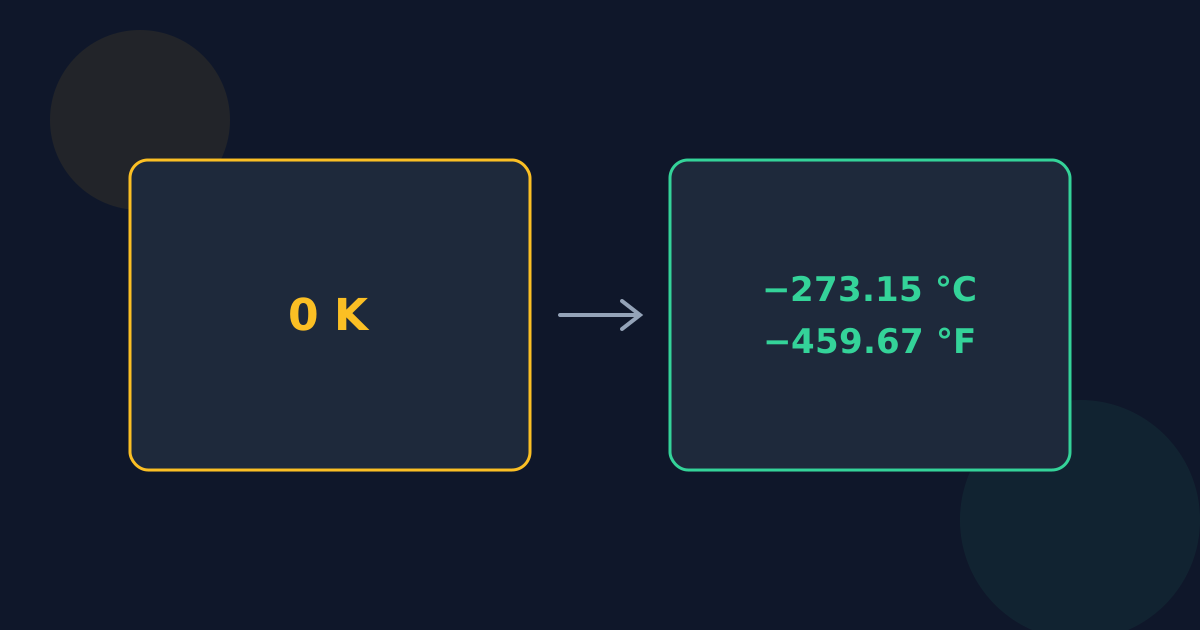
Nothing can be colder than 0 K (−273.15 °C, −459.67 °F), which is why the Temperature Converter rejects lower values rather than returning an impossible answer.
Rankine, a Fahrenheit-sized absolute scale, is rarely used today and isn’t included in the converter.
Celsius, Fahrenheit, Kelvin FAQ
- Can a temperature in kelvin be negative?
- No. 0 K is absolute zero, the lowest possible temperature.
- What is 0 K in Fahrenheit?
- −459.67 °F.
- Why doesn’t kelvin use a degree sign?
- The kelvin is an SI base unit named in its own right, so it is written like other units: 300 K.
- Is a kelvin the same size as a degree Celsius?
- Yes. A change of 1 K equals a change of 1 °C.
- Which scale do scientists use?
- Kelvin for most physics and chemistry, and Celsius for many everyday lab and weather measurements.
Related guides
- Fahrenheit vs. CelsiusLandmark temperatures on both scales, why a Celsius degree is 1.8 Fahrenheit degrees, quick estimates, and where each scale is used.
- Temperature FormulasWhere the 32 and the 5/9 in the Fahrenheit–Celsius formulas come from, how to reverse them, and why temperature differences convert differently.
Open the tool
Jump into Temperature Converter when you are ready to process your files.