Home, moving & space
How Long an Item Can Turn a Hallway Corner
Whether a long piece of furniture gets round a hallway corner is one of the few moving questions with an exact answer. For a rigid item carried level round a square corner, the longest that can make the turn depends only on the two hallway widths and the item’s width. This guide explains where that limit comes from, gives it for common hallway and furniture widths, and shows what changes it.
Ready to try the tool this guide describes?
Why the corner sets a length limit
Seen from above, an item going round a corner is a rectangle pivoting about the inside corner of the walls. Partway through the turn its outer side spans from one outer wall to the other, and the room along that side is smallest at one particular angle. If the item is longer than that, it jams there — however it is wiggled, as long as it stays level and rigid.
For hallways A and B wide and an item w wide, the room at angle φ is (A − w·cos φ)/sin φ + (B − w·sin φ)/cos φ, and the longest item that can turn is the smallest value of that over every angle. For two equal hallways the tightest angle is 45°, and the limit is 2√2 × A − 2w.
Longest item that can turn, by width
| Item width | Two 30 in hallways | Two 36 in hallways | Two 42 in hallways |
|---|---|---|---|
| 16 in | 52.85 in | 69.82 in | 86.79 in |
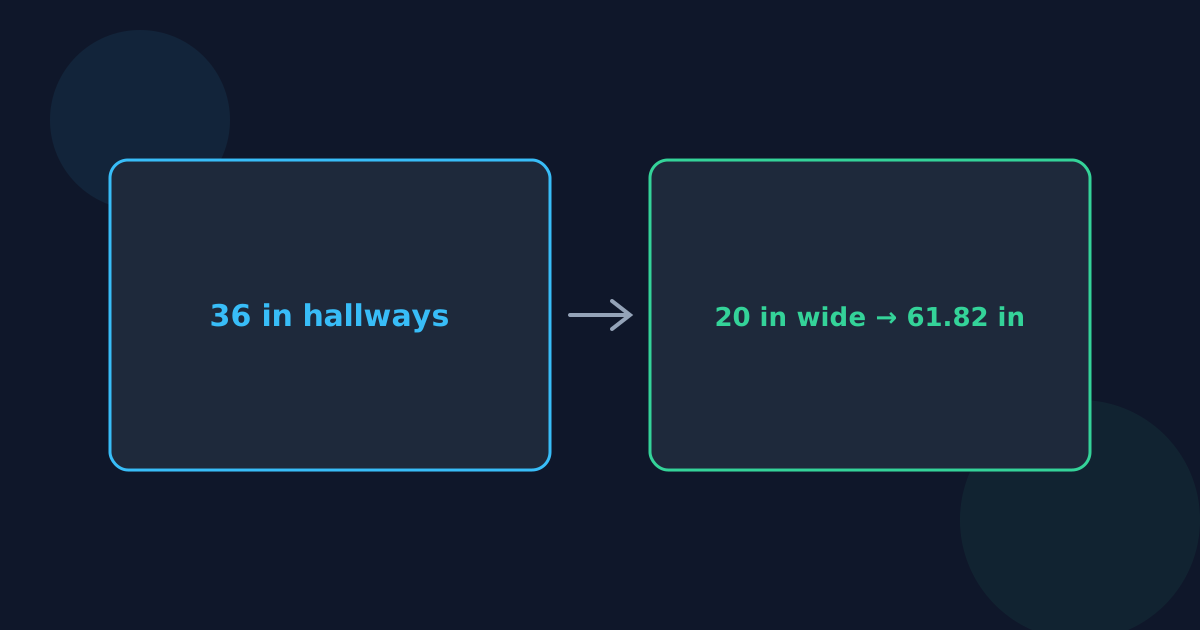
| 20 in | 44.85 in | 61.82 in | 78.79 in |
| 24 in | 36.85 in | 53.82 in | 70.79 in |
| 30 in | 30 in | 41.82 in | 58.79 in |
Rigid items carried level round a square corner. In two 30 in hallways a 30 in-wide item can’t pivot at all; it only gets round by sliding through the corner without turning, so the limit is the hallway width itself.
What the numbers show
- Width matters as much as length: every 2 in of extra item width costs 4 in of turnable length when the hallways are equal.
- A wider hallway helps on either side. With a 30 in-wide item, two 32 in hallways allow only 32 in, a 42 in and a 32 in allow 43.15 in, and two 42 in hallways allow 58.79 in.
- Short items don’t need to pivot at all: anything no longer than one hallway’s width, and no wider than the other’s, slides through the corner square.
When the limit isn’t the end of it
The limit is for an item kept level. Standing it on end, or lifting one end steeply, changes what the corner sees from above, and can get far longer pieces round — if the ceiling allows. A T-junction, where the hallway carries on past the turn, also gives more room than a plain corner. Those need their own check rather than this table.
Hallway Corner Length Limit FAQ
- Is there a formula for moving furniture around a corner?
- Yes, for a rigid item carried level: the longest that can turn is the minimum over the turning angle of (A − w·cos φ)/sin φ + (B − w·sin φ)/cos φ.
- Why does a wider item get stuck sooner?
- Because the item’s width eats into the room along its outer side at every angle, twice over for equal hallways.
- Does the order of the hallways matter?
- No. The limit is the same turning from the wide hallway into the narrow one as the other way round.
- What is the ladder version of this problem?
- The same formula with no width: the longest pole that can be carried round the corner, (A^⅔ + B^⅔)^{3/2}.
- Do skirting boards and trim count?
- Yes. Measure each hallway’s clear width at its narrowest point near the corner, including trim, radiators, and rails.
Related guides
- Standing Furniture on EndWhy standing a sofa on end gets it round a corner it can’t turn level, when lifting one end helps and when it makes things worse, and how much ceiling it takes.
- Measuring a HallwayWhat to measure in a hallway before moving furniture round a corner: the narrowest clear widths, the lowest point overhead, the kind of turn, and the obstacles people miss.
Open the tool
Jump into Hallway Corner Turn Calculator when you are ready to process your files.