Work, pay & shifts
The 4-On-4-Off Schedule Explained
A 4-on-4-off schedule is exactly what it sounds like: four days of work, then four days off, repeating without a break. It is popular for 12-hour shifts in policing, manufacturing, mining, and healthcare because it gives long, regular stretches of rest. What surprises people is how it interacts with the calendar — the days you work move every cycle. This guide explains the cycle, the weekday drift, weekends, and typical hours.
Ready to try the tool this guide describes?
The 8-day cycle
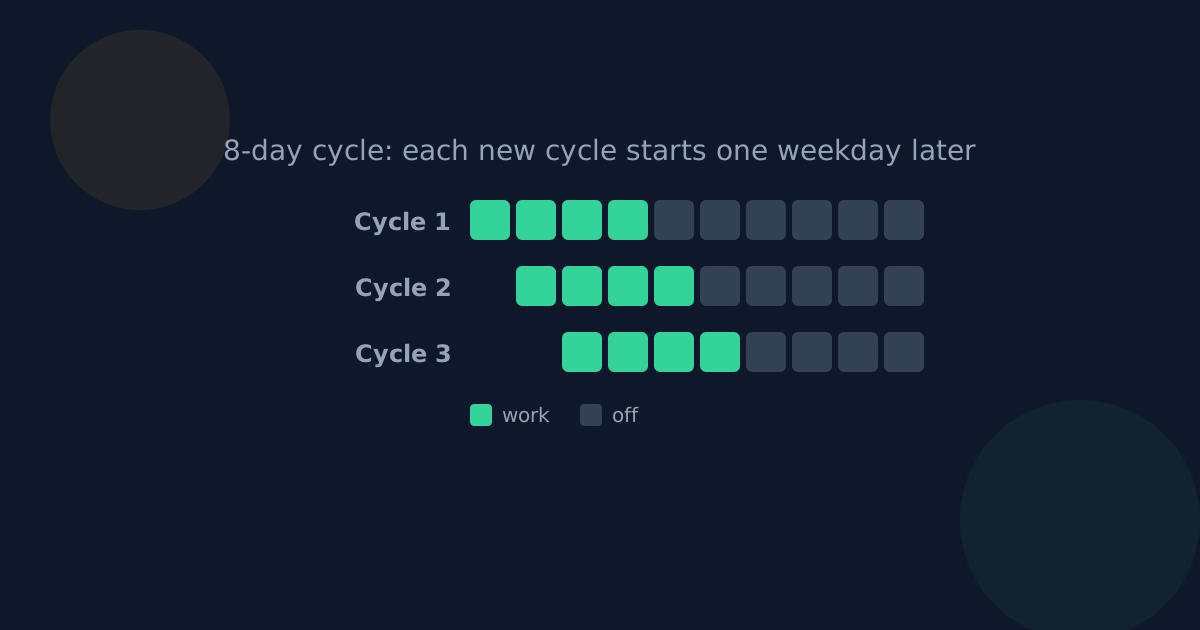
One cycle is 4 work days followed by 4 days off: 8 days in all, with work on exactly half of them. It repeats indefinitely, independent of weeks or months. Most 4-on-4-off jobs use 12-hour shifts, so one cycle is 48 hours of work.
Why your days off move
Eight days is one day longer than a week, so each new cycle starts one weekday later than the one before. If your first work day is a Monday, the next cycle starts on a Tuesday, then a Wednesday, and so on. After 7 cycles — 56 days — the first work day lands on a Monday again and the whole pattern of weekdays repeats.
| Cycle | Work days | Days off |
|---|---|---|
| 1 | Mon – Thu | Fri – Mon |
| 2 | Tue – Fri | Sat – Tue |
| 3 | Wed – Sat | Sun – Wed |
| 4 | Thu – Sun | Mon – Thu |
Weekends
Because the days drift, weekends off come and go. Over the 56 days of a full weekday cycle that starts on a Monday work day, 3 of the 8 weekends have both Saturday and Sunday off. Others are split, with one day on and one off, or fully worked.
Hours in a week and a pay period
- Any 7 days contain either 3 or 4 work days, because a week is one day short of a full cycle. With 12-hour shifts, that is 36 or 48 hours.
- The long-run average is 3.5 shifts a week: 42 hours at 12 hours a shift.
- A 14-day pay period contains 6, 7, or 8 shifts — 72, 84, or 96 hours with 12-hour shifts.
By shift length
| Shift length | Hours per cycle | Weekly range | Average week |
|---|---|---|---|
| 8 hours | 32 | 24 – 32 | 28 hours |
| 10 hours | 40 | 30 – 40 | 35 hours |
| 12 hours | 48 | 36 – 48 | 42 hours |
4-On-4-Off Explained FAQ
- What is a 4-on-4-off schedule?
- A rotation of four work days followed by four days off, repeating every 8 days. It is usually worked with 12-hour shifts.
- Why do my work days change weekday each cycle?
- An 8-day cycle is one day longer than a week, so each cycle starts one weekday later. The weekday pattern repeats every 56 days.
- How many hours a week is 4 on, 4 off?
- Either 36 or 48 in any given week with 12-hour shifts, and 42 on average.
- How often do I get a full weekend off on 4 on, 4 off?
- It depends on where your cycle starts. Starting on a Monday work day, 3 of every 8 weekends are fully off.
- Is 4 on, 4 off full time?
- With 12-hour shifts it averages 42 hours a week. Whether that counts as full time is up to the employer.
Related guides
- 4-On-4-Off Hours per YearThe average and exact work days and hours in a year on 4 on, 4 off, why the count is 181 to 184 days, leap years, and a comparison with 2,080 hours.
- Finding 4-On-4-Off Work DaysUse one known work day and the day count mod 8 to tell whether any future or past date is a work day or a day off, with a spreadsheet formula.
Open the tool
Jump into 4-On-4-Off Work Schedule Calculator when you are ready to process your files.