Shipping & packaging
Why Void Fill Use Differs From Empty Box Space
Subtracting a product’s volume from a box’s volume gives a tidy number for the empty space. In practice, packers rarely use exactly that much fill — sometimes more, sometimes less — and occasionally the numbers say there is room when the product won’t go in at all. Knowing why helps you read a void-fill estimate sensibly.
Ready to try the tool this guide describes?
Materials don’t behave like water
- Loose fill settles, so a box that was full at packing has a gap at the top on arrival.
- Air pillows are fixed shapes that can’t reach into corners or narrow gaps.
- Paper compresses under load, so more goes in than the empty volume suggests.
Gaps between products count as empty space
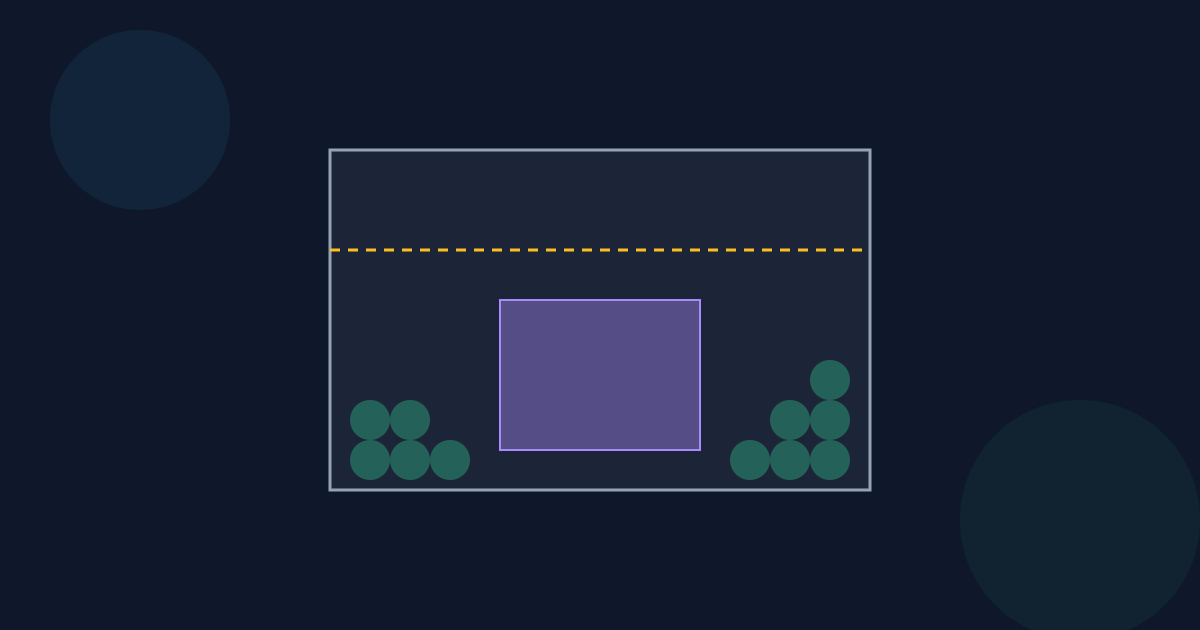
Two 6 × 4 × 4 in products in a 12 × 12 × 8 in box take 192 in³, leaving 960 in³. The calculation counts every gap between them as space to fill, whether or not your fill can reach it. Filling 75% of the empty space — 720 in³ — is often closer to what happens.
Matching volumes don’t mean a fit
Volume says nothing about shape. A 20 × 2 × 2 in product is only 80 in³, and a 12 × 12 × 8 in box holds 1,152 in³ — yet the product can’t go in at any angle, because it is longer than the box’s longest diagonal, about 18.76 in.
Likewise, products that add up to most of a box’s volume may not arrange inside it at all, let alone with cushioning.
Treat volume subtraction as a cost estimate, not a packing plan.
Getting closer to reality
- Check that each product fits the box placed square to its sides.
- Lower the fill share for materials that leave gaps.
- Pack a sample and measure the fill used.
- Use the measured figure to set the share for future estimates.
Void Fill vs Empty Space FAQ
- Why does my box use more void fill than calculated?
- Paper compresses and loose fill settles, so more material goes in than the empty volume suggests.
- Why does it use less?
- Air pillows and other fixed shapes can’t fill corners and narrow gaps, so some empty space stays empty.
- Can a product fit by volume but not physically?
- Yes. A 20 × 2 × 2 in product is far smaller than a 12 × 12 × 8 in box by volume, but it is longer than the box’s longest diagonal.
- Does the calculation check that my products fit?
- Volume subtraction can’t. A good calculator warns when a product is bigger than the box in any direction, but it can’t prove an arrangement works.
- What fill share should I use for multiple products?
- Start below 100% to allow for gaps your fill can’t reach, then adjust after packing a sample.
Related guides
- Void Fill Cost per PackageHow to estimate the void fill a package needs and what it costs, from the box’s inside size, the product, and your material price per volume.
- Void Fill Materials ComparedHow air pillows, packing peanuts, and paper void fill compare for filling space, how each is priced, and how to turn those prices into a cost per volume.
Open the tool
Jump into Dunnage / Void-Fill Cost Calculator when you are ready to process your files.