Shipping & packaging
What Package Density Tells You
A density figure says whether a package is heavy or light for its size. That one number helps explain why some shipments fill a truck long before they reach its weight limit, why light parcels get priced by size, and when a weight looks wrong.
Ready to try the tool this guide describes?
Heavy for its size, or light for its size
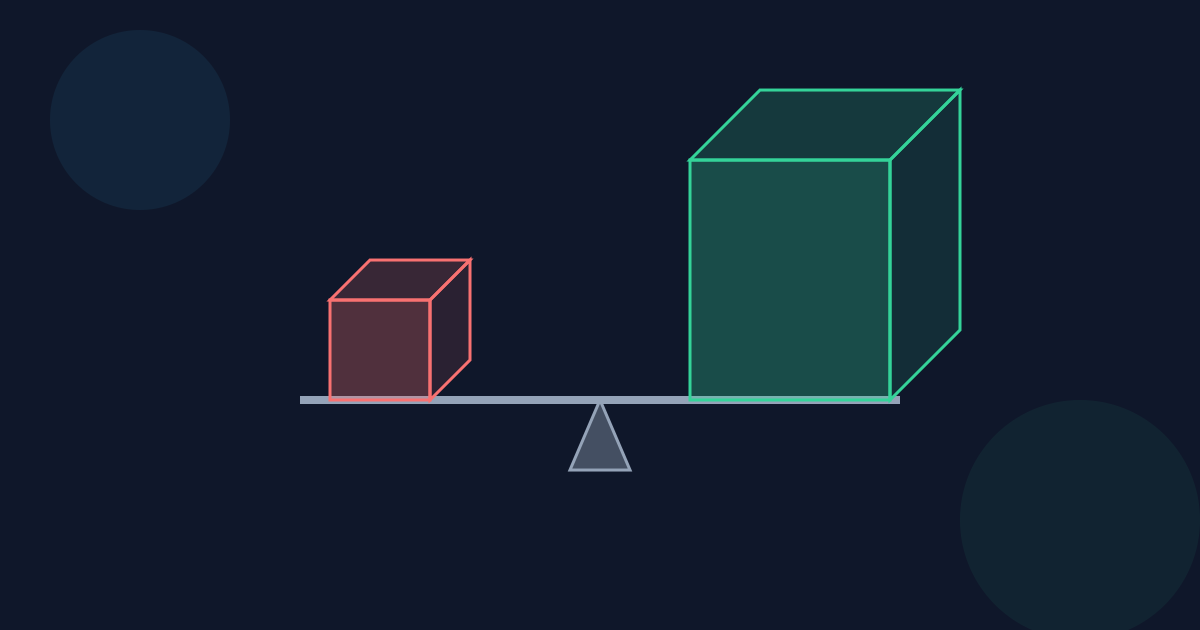
Density puts weight and size on one scale. A 12 × 12 × 12 in box weighing 10 lb and a 24 × 24 × 24 in box weighing 10 lb weigh the same, but the first is 10 lb/ft³ and the second 1.25 lb/ft³ — it takes eight times the space for the same weight.
A reference point: water
Fresh water is about 1,000 kg/m³, or 62.43 lb/ft³. Most packed boxes are well below that, because they contain air, packaging, and products lighter than water. A package close to water’s density is unusually heavy for its size — worth double-checking if you didn’t expect it.
Low density: space runs out first
Low-density shipments run out of room before they run out of weight allowance. A truck or container full of light, bulky boxes is full by volume while still far under its weight limit. That is why carriers that price parcels by size use dimensional weight: it bills a large, light box as if it were heavier.
High density: weight runs out first
High-density shipments reach weight limits first — of a box, a shelf, a pallet, or a vehicle — while leaving space unused. Dense packages also need sturdy boxes and careful stacking, because the cartons beneath them carry more weight.
Using density to compare
- Density doesn’t depend on how many boxes there are, only on how heavy each is for its size, so it compares loads fairly.
- Convert before comparing: 10 lb/ft³ is about 160.2 kg/m³.
- For billing questions, use the carrier’s own divisor with the box’s dimensions rather than density alone.
What Density Tells You FAQ
- What counts as a high package density?
- There is no single cut-off; it depends on the use. As a reference, water is about 62.43 lb/ft³ (1,000 kg/m³), and most packed boxes are well below it.
- Why can a light, bulky box cost more to ship than its weight suggests?
- Because space costs carriers too. Carriers that price by size bill a low-density box at its dimensional weight when that is more than its actual weight.
- Does density change if I ship more boxes of the same product?
- No. Ten identical boxes weigh ten times as much and take ten times the space, so the density is the same.
- What does a density higher than water mean?
- That the package is very heavy for its size — normal for metal parts or bottled liquids, but worth checking the weight and measurements otherwise.
- Is a denser package better for shipping?
- Often. The same product in a smaller box uses less space and is less likely to be billed at a dimensional weight, as long as it is still protected.
Related guides
- Calculating Package DensityHow to work out a package’s density from its size and weight in pounds per cubic foot or kilograms per cubic meter, with worked examples and pallet tips.
- lb/ft³ vs kg/m³How to convert density between pounds per cubic foot and kilograms per cubic meter, where the 16.0185 factor comes from, and a quick conversion table.
Open the tool
Jump into Package Density Calculator when you are ready to process your files.