Work, pay & shifts
PTO Accrual Rate Per Pay Period: Reference Table
Policies usually state PTO as hours or days a year, while pay stubs show hours per pay period. This reference converts common annual allowances into per-period rates for every pay frequency, and explains the small rounding and calendar effects that make your stub differ from a simple division.
Ready to try the tool this guide describes?
Annual hours to hours per pay period
Each figure is the annual allowance divided by the standard number of periods, rounded to 2 decimal places.
| Annual PTO | Weekly (52) | Biweekly (26) | Semi-monthly (24) | Monthly (12) |
|---|---|---|---|---|
| 40 hours | 0.77 | 1.54 | 1.67 | 3.33 |
| 80 hours | 1.54 | 3.08 | 3.33 | 6.67 |
| 120 hours | 2.31 | 4.62 | 5 | 10 |
| 160 hours | 3.08 | 6.15 | 6.67 | 13.33 |
| 200 hours | 3.85 | 7.69 | 8.33 | 16.67 |
Policies written in days
Multiply the days by the hours in your workday first. 10, 15, 20, and 25 eight-hour days are 80, 120, 160, and 200 hours — the rows above. With 7.5-hour days, 15 days is 112.5 hours, or about 4.33 hours per biweekly period.
What rounding the rate does over a year
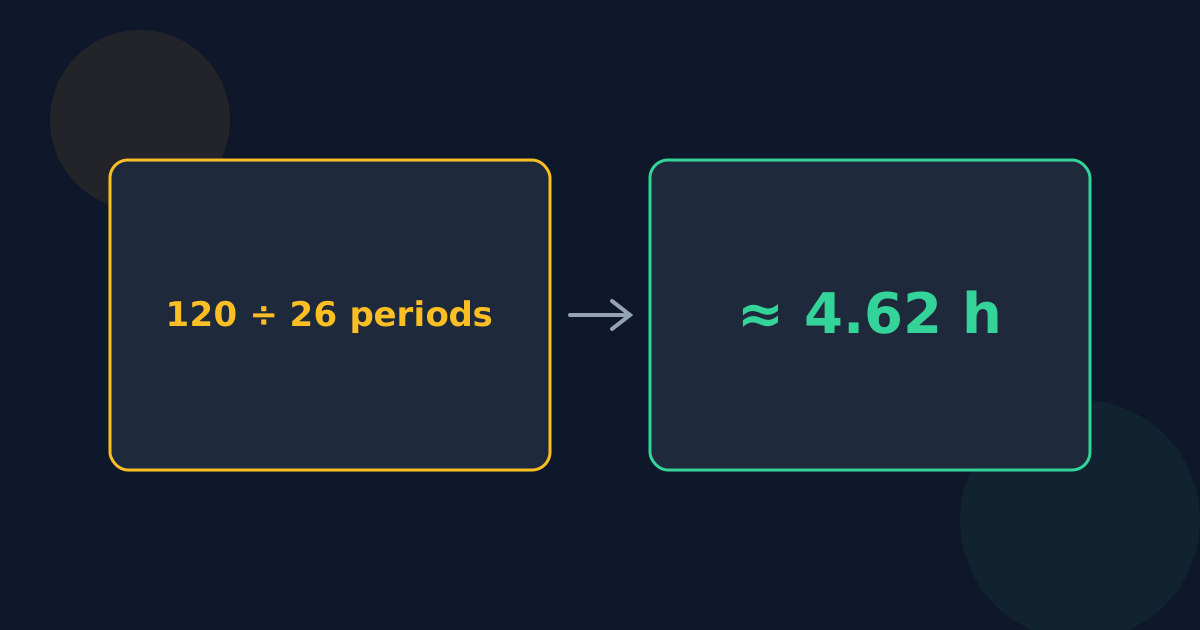
120 ÷ 26 is 4.615384… hours. A payroll system that rounds the rate up to 4.62 credits 26 × 4.62 = 120.12 hours in a year; one that rounds down to 4.61 credits 119.86. Systems that keep more decimals, or that true up the total at year end, land on exactly 120. A difference of a tenth of an hour on your stub at year end is usually rounding, not an error.
The 27-paycheck year
A biweekly schedule with a payday on Friday, January 1, 2027 has 27 paydays in 2027. With 120 hours a year, the three ways of handling it give:
| Rule | Per period | Hours in the 27-period year |
|---|---|---|
| Fixed 4.62 hours per period | 4.62 | 124.74 |
| Allowance ÷ periods in the year | 4.44 | 120 |
| Standard rate, stopping at the allowance | 4.62, then 0 in the 27th | 120 |
Weekly pay and 53-week years
Weekly payroll has the same effect more often: a year has 53 paydays when the first one falls early enough in January. At 80 hours a year, a fixed 1.54 hours a week earns 81.62 hours in a 53-week year, while an annual allowance divided by 53 stays at 80.
PTO Rate Per Pay Period FAQ
- How many PTO hours per paycheck is 80 hours a year?
- About 3.08 hours biweekly, 3.33 semi-monthly, 1.54 weekly, or 6.67 monthly.
- Why does my pay stub show 4.62 hours of PTO?
- That is 120 hours a year — 15 eight-hour days — divided by 26 biweekly pay periods.
- Do I get more PTO with semi-monthly pay than biweekly?
- Each paycheck carries more — 5 hours instead of 4.62 for 120 a year — but there are 24 paychecks instead of 26, so the yearly total is the same.
- How do I convert PTO days into hours per pay period?
- Days × hours per day ÷ pay periods a year. 15 days × 8 hours = 120 hours, ÷ 26 ≈ 4.62 hours per biweekly period.
- Is it normal for my PTO total to be slightly off at year end?
- Yes. A rounded per-period rate adds or loses a fraction of an hour each year, and extra-paycheck years add or remove a whole accrual depending on the rule.
Related guides
- PTO Accrual MethodsFront-loaded vs accrued PTO, and how a per-period rate, a per-hour rate, and an annual allowance compare for full-time, part-time, and 27-paycheck years.
- PTO for New HiresHow PTO accrues when you start or leave mid-period or mid-year: prorated periods, waiting periods, and what a calendar-year allowance gives a new hire.
Open the tool
Jump into PTO Accrual Calculator when you are ready to process your files.