Home, moving & space
Picture Wire vs D-Rings vs Sawtooth Hangers
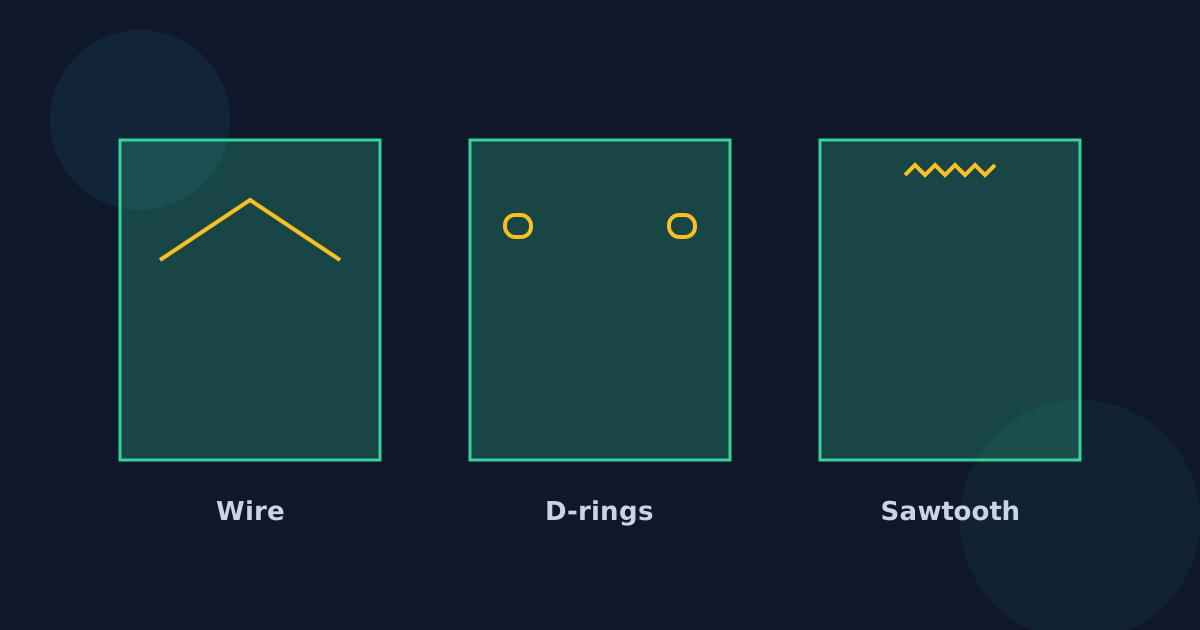
Most frames come with one of three hangers on the back: a wire, a pair of D-rings, or a sawtooth strip. Each one catches the hook in a different place and behaves differently once it is on the wall. Knowing which you have tells you how many hooks to use, how to measure for them, and how likely the frame is to drift off level.
Ready to try the tool this guide describes?
At a glance
| Hanger | Hooks | Where it rests on the hook | Staying level |
|---|---|---|---|
| Picture wire | One (usually) | The wire’s peak when pulled taut | Can slide and tilt |
| Two D-rings | Two | The inside top of each ring | Holds level once both hooks match |
| Sawtooth | One | The notch you choose | Fine-tuned by moving notches |
Picture wire
Wire is forgiving to hang: one nail, and the frame settles under its own weight. The cost is that it can slide along the wire and tilt, and the hook position depends on how much slack the wire has. Its drop is measured to the peak with the wire pulled up, which can be far above the screw eyes it is tied to.
D-rings
A D-ring on each side, each on its own hook, holds a frame flat to the wall and stops it creeping off level. It takes two holes that must be at exactly the same height and the same distance apart as the rings, so it asks for more care when marking the wall. The drop is to the inside top of a ring as the hook will hold it.
Sawtooth hangers
A sawtooth is a small toothed strip across the top of a light frame. It sits on one nail, and moving the frame a notch left or right corrects a slight tilt. Its drop is usually tiny — the teeth are close to the top edge — so the nail goes almost at the frame’s top height.
Choosing between them
- Small, light frames: a sawtooth or a short wire is quick and easy.
- Frames that must stay exactly level, or hang in a row: two D-rings on two hooks.
- Heavy or large frames: check the hanger and the hooks are rated for the weight; many framers use D-rings or heavy-duty hangers here.
- Whatever the hanger, the nail goes below the frame’s top by that hanger’s drop.
Wire vs D-Rings vs Sawtooth FAQ
- Is picture wire or D-rings better?
- D-rings on two hooks keep a frame level and flat to the wall; wire is quicker with one nail but can slide and tilt. Many people use D-rings for frames hung in a row.
- How many nails does a sawtooth hanger need?
- One. The frame sits on a single nail, and choosing a different notch nudges it level.
- Can I hang D-rings on one nail?
- Not directly — each ring needs its own hook. Threading a wire between the rings turns them into a wire hanger on one nail.
- Which hanger has the smallest drop?
- Usually the sawtooth: its teeth are close to the top edge, so the nail goes only a little below where the frame’s top will be.
- Does the hanger type change how high the picture hangs?
- No — the frame’s height is your choice. The hanger only changes where the nail goes to put it there.
Related guides
- Picture Wire LengthHow the length of a picture wire sets where the hook goes: the taut-wire triangle, worked drops for common wire lengths, and how much slack to leave.
- Hanging With Two HooksHang a frame level on two hooks: set both at the same height, space them as far apart as the D-rings, and find their distance from each frame edge.
Open the tool
Jump into Picture Hook / Nail Offset Calculator when you are ready to process your files.