Home, moving & space
How to Properly Tape Moving Boxes
A moving box fails at its weakest seam, and the weakest seams are the ones most people leave untaped. Taping a box properly takes about a minute and a little more tape, and it is the difference between a box that arrives and one that drops its contents in the stairwell. This guide covers building the box, the H pattern, reinforcing heavy boxes, and the common mistakes.
Ready to try the tool this guide describes?
Build the bottom first
- Open the box and fold the two short flaps in, then the two long flaps over them, so the long flaps meet in a seam down the middle.
- Run a strip along that seam, starting a few inches down one side and finishing a few inches down the other.
- Run a strip across each end edge, where the flaps meet the end panels, again down the sides.
- Turn the box over and press every strip down firmly, especially the tabs.
Why the H pattern
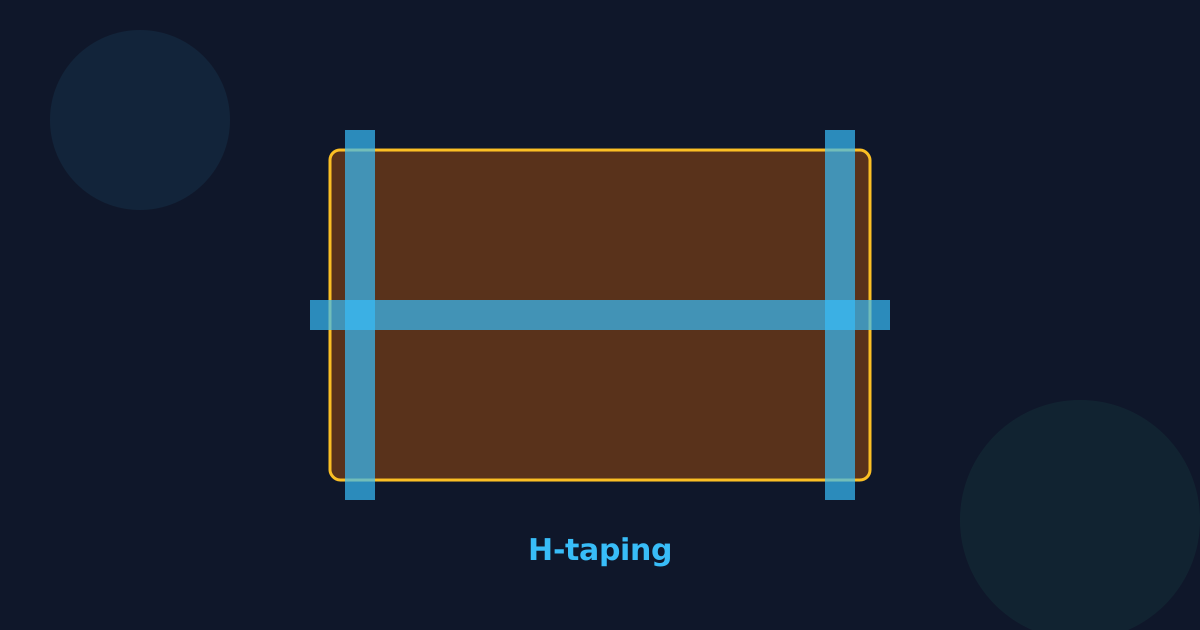
A single strip holds the two long flaps together but leaves the short ends open. Under weight, the flaps bow and the corners split — usually at an end. The two edge strips close those ends, turning the bottom into one panel. On a medium 18 × 18 in box, H-taping the bottom uses 69 in of tape instead of 23 in; that extra 46 in is cheap compared with a box of dishes on the floor.
Heavy boxes: reinforce, don’t overfill
- Add strips across the bottom seam for books, tools, and kitchenware. Each strip across a medium box’s bottom is 23 in with 2.5 in tabs.
- A second strip on the centre seam (double H) adds strength where the flaps meet.
- Use smaller boxes for heavy things. Tape can’t fix a box too heavy to lift safely.
- Fill gaps so the top doesn’t sink; a box crushed from above splits its tape too.
Tabs: how far down the side
Each strip should run a little way down the sides so it grips the panels as well as the flaps. A few inches is common. Longer tabs hold better and use more: H-taping a box top and bottom has twelve tab ends, so every extra inch of tab adds 12 in of tape to each box.
Common mistakes
- Folding the flaps over and under each other instead of taping them; it weakens the box and hides a gap.
- Using office tape or masking tape, which doesn’t hold cardboard under load.
- Taping over old labels and tape from a used box without checking the flaps are sound.
- Leaving tape ends loose — they catch on other boxes and peel.
Taping Moving Boxes FAQ
- What is H-taping?
- A strip along the centre seam plus one across each end edge, making an H. It closes every seam on that face.
- Is one strip on the bottom ever enough?
- For light, small boxes it may hold, but for moving, the end edges are where boxes split. H-taping the bottom is the safer habit.
- Which tape should I use for moving boxes?
- Packing tape made for cartons, typically 48 mm (1.88 in) wide. Wider tape covers more of the edge; it doesn’t change how long each strip is.
- Should I tape the top of the box the same way?
- Yes. Stacked and carried boxes get pressure from every side, and an H-taped top keeps flaps closed when a box is tipped.
- Is a tape gun worth it?
- For more than a few boxes, yes: it cuts cleanly, keeps strips straight, and wastes less tape.
Related guides
- How Much Packing TapeTape per box for small, medium, large, and extra-large moving boxes and for each taping pattern, and how a whole move adds up to whole rolls.
- Tape Roll CoverageRead a packing tape label in yards or meters, see how many boxes a 60 yd roll seals by box size, and why the last roll always has tape left.
Open the tool
Jump into Packing Tape Calculator when you are ready to process your files.