Home, moving & space
How to Calculate Curtain Stack-Back and Rod Extension
Stack-back can be estimated with a short calculation: find how much fabric gathers across the rod, take a share of it for the stack, and compare that with how far the rod runs past the window. The one subtle step is that a longer rod needs more fabric at the same fullness — so the extension has to be solved for, not just copied from the stack.
Ready to try the tool this guide describes?
Step 1: the fabric
With a fullness in mind, the fabric is the rod width times the fullness, plus any returns and overlap. A 48 in window with the rod 8 in past each side has a 64 in rod; at 2× that is 128 in of finished curtain width. If you already own the panels, the fabric is simply the number of panels times one panel’s width.
Step 2: the stack
Take off the fabric that wraps the returns — it folds round to the wall rather than across the rod — and multiply the rest by the stack factor for your heading. At about 20% for pinch pleats, 128 in stacks about 25.6 in: 12.8 in at each end for a pair.
Step 3: the glass covered
Any stack wider than the extension hangs over the glass. With 12.8 in of stack and an 8 in extension, 4.8 in of glass is covered at each side — 9.6 in in all, leaving 38.4 in of a 48 in window clear when the curtains are open.
Step 4: solve for the extension
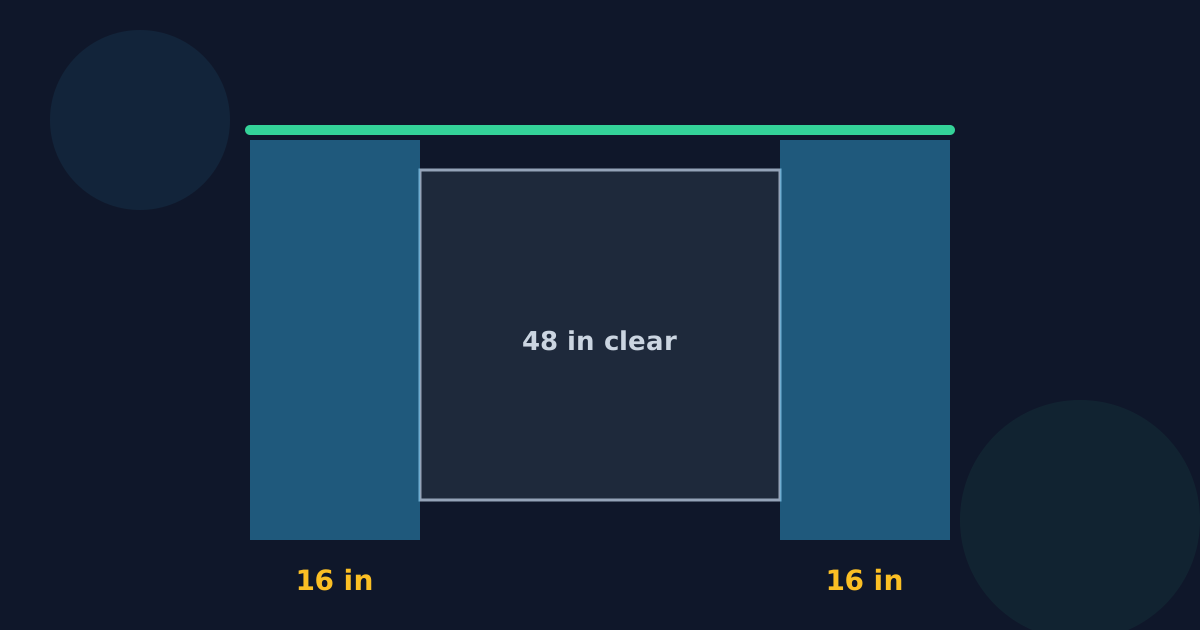
Extending the rod to 12.8 in a side doesn’t quite work, because the longer rod needs more fabric, which stacks wider again. For a pair at a set fullness, the extension that exactly matches its own stack is the stack factor × (fullness × window + overlap) ÷ (2 × (1 − stack factor × fullness)). For the 48 in window that is 0.2 × 96 ÷ 1.2 = 16 in each side, an 80 in rod whose 160 in of fabric stacks exactly 16 in each side.
If stack factor × fullness reaches 1, every inch of rod adds at least an inch of stack, and no extension clears the glass.
More worked results
| Window | Fabric | Heading | Extension to clear | Rod |
|---|---|---|---|---|
| 48 in, pair | 2× fullness | Pinch pleat (20%) | 16 in each side | 80 in |
| 72 in, pair | 4 panels of 54 in | Grommet (15%) | 16.2 in each side | 104.4 in |
| 120 cm, one way | 2.5× fullness | Wave (15%) | 81 cm on the open side | 216 cm |
The one-way rod keeps 15 cm on the far side. With panels, the fabric is fixed, so the extension equals the stack.
Calculating Stack-Back FAQ
- How do you calculate curtain stack-back?
- Multiply the fabric that gathers across the rod by a stack factor for the heading — about 20% for pinch pleats. 128 in of fabric stacks about 25.6 in, 12.8 in each side for a pair.
- Why isn’t the rod extension just the stack width?
- With a set fullness, a longer rod needs more fabric, which stacks wider. Solving for that gives 16 in each side for a 48 in window at 2×, not 12.8 in.
- Does the curtain return count toward stack-back?
- No. Fabric that wraps the return goes back to the wall, so it is taken off before the stack is worked out.
- How much glass will my open curtains cover?
- The stack on each side minus the extension on that side, if more. 12.8 in of stack on an 8 in extension covers 4.8 in of glass at each side.
- How do I work out stack-back for curtains I already own?
- Use the panels’ total width as the fabric. Four 54 in grommet panels are 216 in, which at about 15% stacks 32.4 in — 16.2 in each side.
Related guides
- Stack-Back by HeadingHow much pinch pleat, rod pocket, tab top, grommet, and wave curtains stack when open, with worked widths and what else makes a stack wider.
- Open Curtains Blocking GlassWhy open curtains still cover the window, and practical ways to fix it: a longer rod, a tighter-stacking heading, less fullness, or a one-way draw.
Open the tool
Jump into Curtain Stack-Back Calculator when you are ready to process your files.