Text & writing
Character Count With Spaces vs. Without Spaces
When someone asks for a character count, the first question is: with spaces, or without? The two numbers answer different questions, and using the wrong one can put you hundreds of characters off in a long document. This guide explains what each count includes, who typically uses which, and how to tell which one a requirement means.
Ready to try the tool this guide describes?
What each count includes
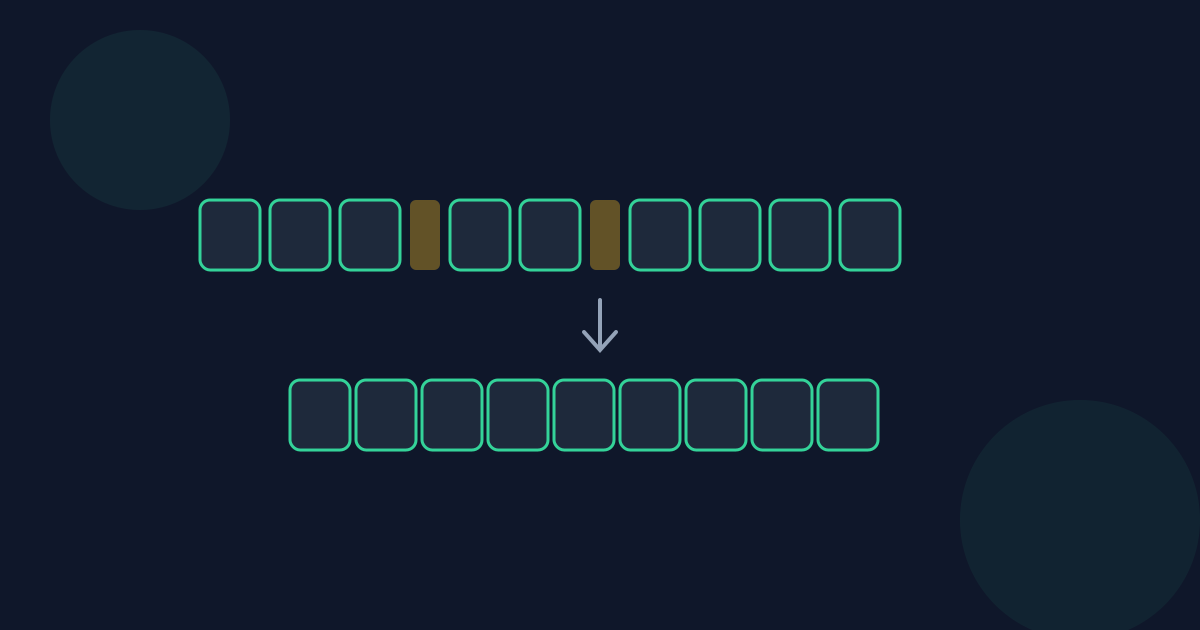
“Without spaces” is really “without whitespace”: it leaves out every kind of blank, not just the space bar. Everything visible still counts in both totals.
| Character | With spaces | Without spaces |
|---|---|---|
| Letters and digits | Counted | Counted |
| Punctuation and symbols | Counted | Counted |
| Emoji | Counted (1 each) | Counted (1 each) |
| Spaces | Counted | Not counted |
| Tabs | Counted | Not counted |
| Line breaks | Counted (1 each) | Not counted |
| Non-breaking spaces | Counted | Not counted |
How big the gap is
In ordinary English prose, roughly one character in six is a space, because an average word is around four to five letters plus the space after it. So a 1,000-character paragraph often has somewhere near 830–850 characters without spaces. Text with long words, lots of numbers, or code has fewer spaces; text with many short words or line breaks has more.
That gap is why confusing the two counts matters: a 3,000-character limit read as “without spaces” allows noticeably more writing than the same limit read as “with spaces”.
Which count different situations usually mean
- Web forms, social posts, text messages, and search snippets measure what you type into the box, so spaces are included.
- Translation and localization work is often quoted per character, and some agencies use the count without spaces so that spacing and formatting do not change the price. Check the quote.
- Academic and application limits stated in characters vary by institution; some specify “including spaces”, others “excluding spaces”.
- Word processors report both figures in their statistics panels, which is why requirements written by people who use them often say which one they mean.
When a requirement doesn’t say
If a limit says only “characters”, assume spaces are included — it is the stricter reading, so you stay safe either way. If the limit is enforced by a text box, the box itself answers the question: paste your text and see whether it is accepted.
When the number really matters, such as a paid translation or a formal submission, ask which count applies and note the answer.
With vs. Without Spaces FAQ
- Which is larger: characters with spaces or without?
- With spaces is always equal or larger, because it includes everything in the without-spaces total plus every space, tab, and line break.
- If a limit just says “characters”, which count should I use?
- Use the count with spaces unless told otherwise. It is the stricter of the two, and it is what most text boxes and online platforms measure.
- Why would anyone use the count without spaces?
- It measures only the visible content, so it is not affected by spacing style, double spaces after periods, or line-break formatting. That makes it popular for pricing translation and for some academic limits.
- Does a double space after a period count twice?
- Yes, in the with-spaces total each space is a character. It has no effect on the without-spaces total.
- Are line breaks counted in characters without spaces?
- No. Line breaks, tabs, and all other whitespace are excluded from the without-spaces total and included in the with-spaces total.
Related guides
- Character Limits ExplainedHow common character limits are really measured — SMS segments, posts on X, search snippets, and web form fields — plus practical techniques for writing to a limit.
- Emojis, Line Breaks & UnicodeWhy one emoji can count as 1, 2, or 11 characters, how Windows and web line breaks differ, and how graphemes, code points, and UTF-16 units change a character count.
Open the tool
Jump into Character Counter when you are ready to process your files.